

Make remotes great again
Or how we lost something truly special

I often think about the stereo my Dad had in the 90s. It was a set of space grey Denon separates, a handsome monstrosity looming over the thick beige carpets and yellowed floral curtains of the living room. I was obsessed with it. Yeah, the fact it played music was cool, but I never really connected the sound it produced to the machine itself — that was clearly the work of other people. What really got me, what still holds a vice-like grip over my imagination, was when you used the remote to change the volume, the physical dial on the amplifier moved as well.
Turn it up, the dial moved clockwise. Turn it down and it spun the other direction. Anywhere in the room. Anywhere. Up and down. Clockwise and anti-clockwise. The sort of unadulterated magic that leads to cartels giving folks rather aggressive haircuts.
So here’s a theory: technology peaked with remote controls. If progress stopped there, we’d be happy. There wouldn’t be any cryptocurrencies or wars or flashmobs or people videoing fireworks on their phones and then showing you the videos of those fireworks on their phones and telling you how good those fireworks were.
Sadly, there is context for this. I had to replace an old remote.
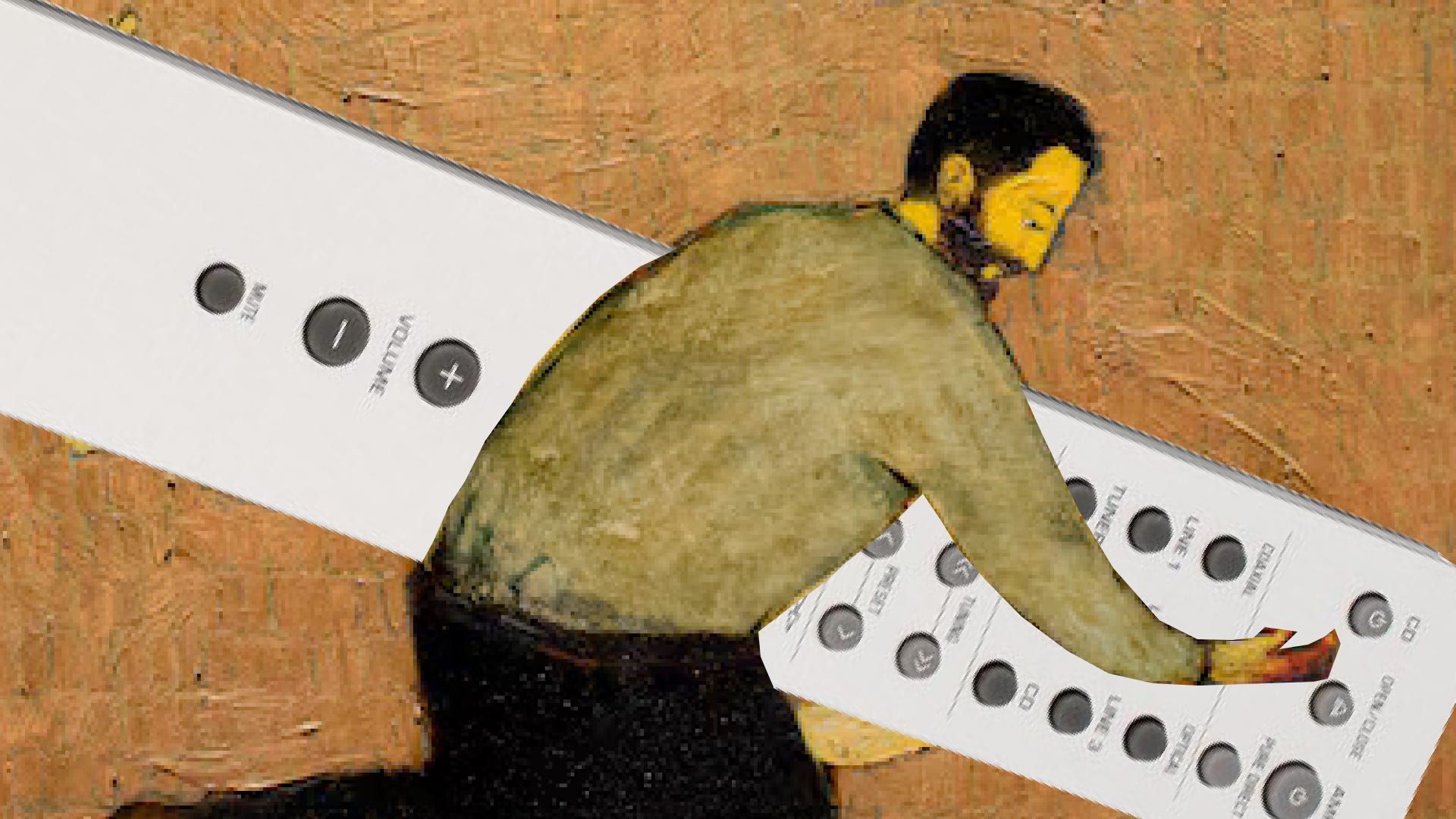
My amplifier is one of my most treasured possessions. Ever since my early twenties where I maxed out a credit card and over-extended myself financially, it’s been integral to The General Enjoyment Of My Life. A fan of that fraud Freud would draw some sort of line from this reckless disregard for my bank account and childhood memories of my Dad’s stereo, but that would be a rather boring thing to say. What’s wrong with me is far more obscure and troubling.
In the 13-odd years I’ve owned the amplifier, I’ve used it almost every day. In that time the remote has seen a battering worthy of a journeyman boxer, a veritable Peter Buckley. Name a surface — marble, concrete, wood, whatever you fancy — and I can guarantee this remote has probably tumbled off a sofa or table onto it.
Its death was slow. Tedious, even. But to be fair to the amplifier remote, it never entirely stopped working, you just had to slap it around a bit before it did what you wanted to.
Sidenote: Another thing modern technology took from us is the physical connection with hardware. Back in the day you could assault something into working by giving it a good old wallop. I’m sure the “rational” and “reasonable” explanation for this working is down to confirmation bias or some other type of psychological skullduggery, but, by gum, it felt like it helped and that’s enough. Try smacking your OLED TV into order and see where that gets you.
There’s a balancing point when it comes to malfunctions. If something works just well enough, you’ll suffer a minor inconvenience to avoid the bigger inconvenience of actually doing something about it. Like a phone charger that kinda works but you need to wiggle it a lot. Sure, you’d save a few seconds once a day if you got a new one, but is that worth actually going online and ordering it? Be serious, now. We’re busy people with social media feeds to refresh.
My amplifier remote was stuck in that inconvenient valley for some time. Eventually, the ignominy of interacting with a treasured possession in this way got too much. Changing audio channels or tweaking the volume should be easy. So — a mere five years after I started noticing the remote wasn’t working well — I picked up a replacement.
The upgraded (read: regular) experience was so good it solidified my theory: all humanity craves are remotes. It’s why Click exists. It’s why all of us secretly hunger for the Megatron, even if it means we’ll be tarred as sofa masturbators. It’s why it’s called remote working.
What makes remotes special is we can just about understand them. You point one at a specific thing and that specific thing then does a specific thing. The remote fires out some sort of light to a receiver that accepts that light. You cannot play Doom on a remote, nor can you send a cryptic 2am text to someone you used to work with requesting their presence on some sort of psychosis-fuelled quest.
I get a remote. A phone I certainly do not get.
When I look at that shiny rectangle I’m an ape around an obelisk, I’m howling and thumping my chest and deadly afraid — I know nothing of its mysteries; what do you mean I can video call my relatives from the other side of the world, order a Pad Thai, and use a compass all on the same device? What are you talking about? What the hell are you talking about? How does it do that? What part of it does all those things? What are you talking about?
There’s comfort in a remote. Comfort and the promise of easier times. There should be more remotes, honestly. Everything’s an app now, and while apps have their place (I wouldn’t want to have some sort of water diviner remote giving me directions) they can also be fiddly and non-ergonomic and ask for my email and require me to slalom through a thousand flashing notifications in order to turn my kettle on. Give me a remote or give me, well, maybe not death, but fewer apps at least. Something that’s more understandable.
Click the button and the wheel turns. That’s not too much to ask for.